RevUp: An AI Claims Assistant for trusted decision support

Transforming a fragmented, manual workflow into a faster and more reliable experience for internal claims specialists.

The impact

We created a tool Sharp employees would utilize in order to support their work and reduce friction in their day-to-day work.
50%
faster claims research, reducing the time required for specialists to validate responsibility and determine the appropriate next steps
75%
of users reported confidence in the output
100%
of users reported less context switching across systems

The challenge

The initiative began with a broad business challenge: claims specialists were spending significant time researching rejected claims across disconnected systems, making it difficult to quickly identify responsibility and determine the appropriate next action. Leadership recognized that emerging AI technologies might help solve this problem, but the product itself was still undefined. It wasn’t yet clear whether the right solution was conversational AI, intelligent search, workflow automation, or something else entirely. My role was to understand the underlying workflow, define the user problem, and help shape the product strategy as the technical direction became clearer through discovery.

Understanding the real workflow

I began by shadowing claims specialists to understand how rejected claims were researched and resolved. The goal was to understand where the workflow broke down and what kind of product would create the most value. The research revealed that the biggest challenge wasn’t simply finding information but synthesizing trustworthy information from multiple disconnected sources. Pain points included:

• Context switching
• Manual synthesis
• Difficulty verifying information
• Slow research
Claims specialists did not need another search engine to aid discovery. They needed something that would gather and organize evidence fro them so they can move foward with a confident decision.
Exploring the solution space

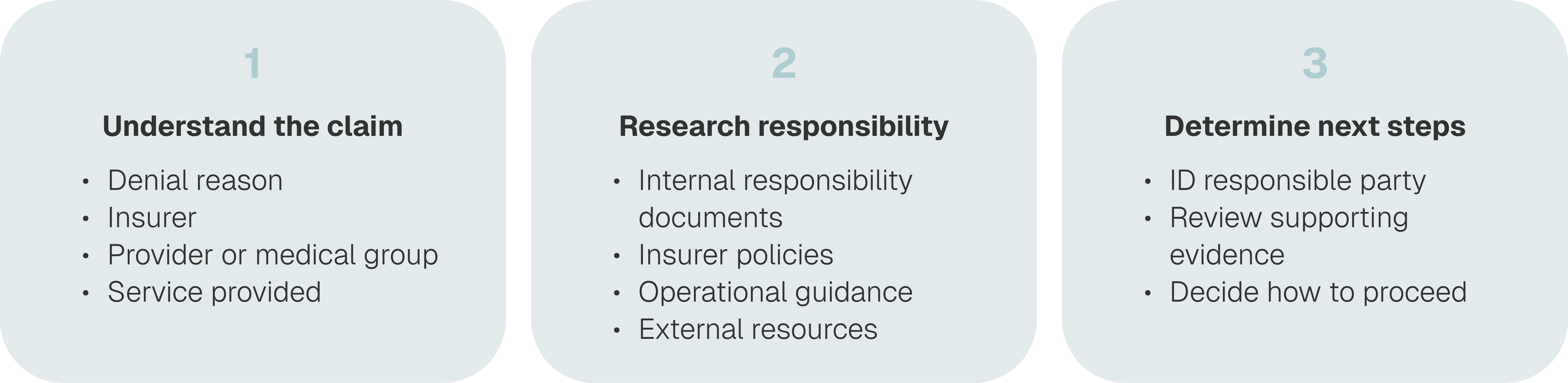
The workflow demonstrated by the claims team uncovered the complexity of their tasks and helped me to organize their work into three stages:
Because claims decisions carry financial and operational consequences, the solution had to be a decision-support product rather than an automated decision-maker. It became clear overtime a retrieval-augmented AI experience could reduce that burden on the users.

Iterating toward the right solution

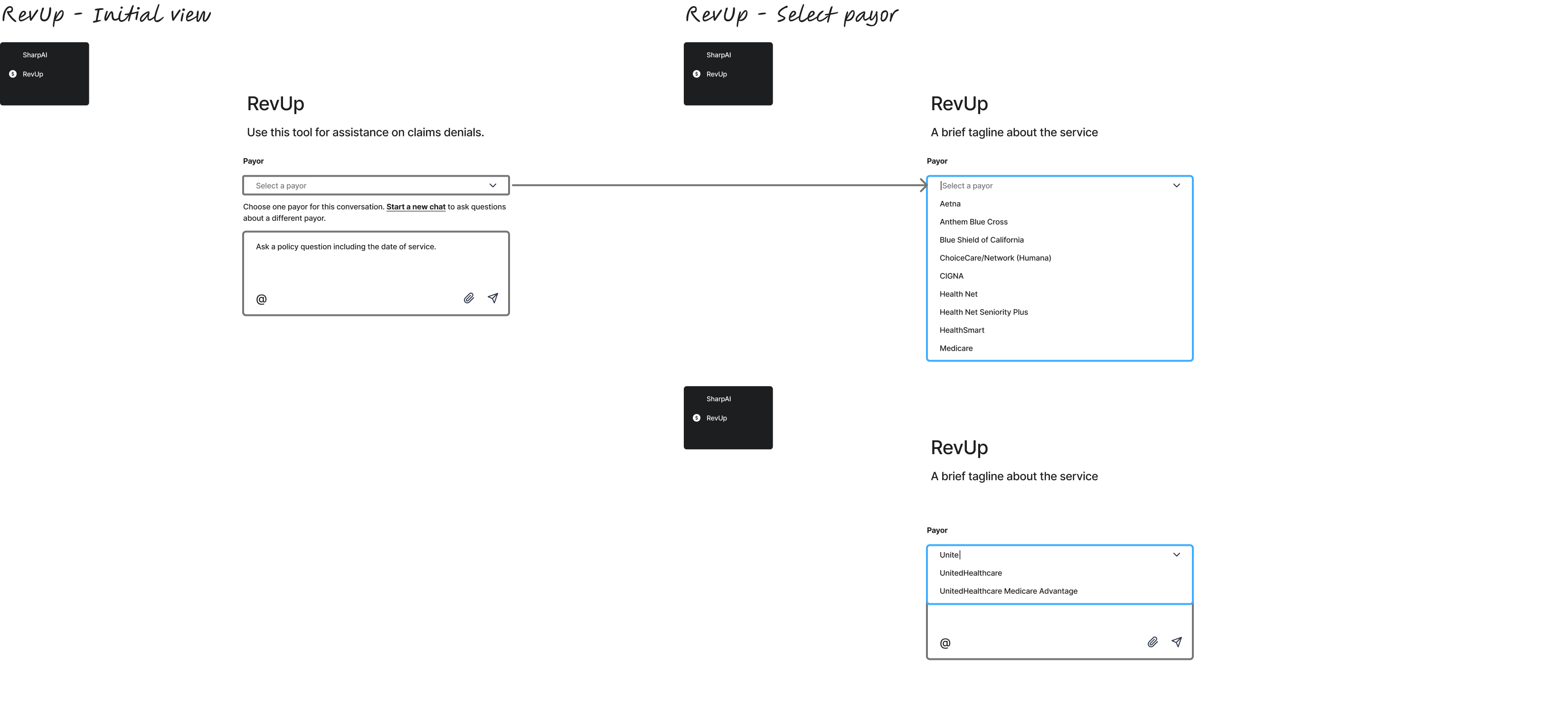
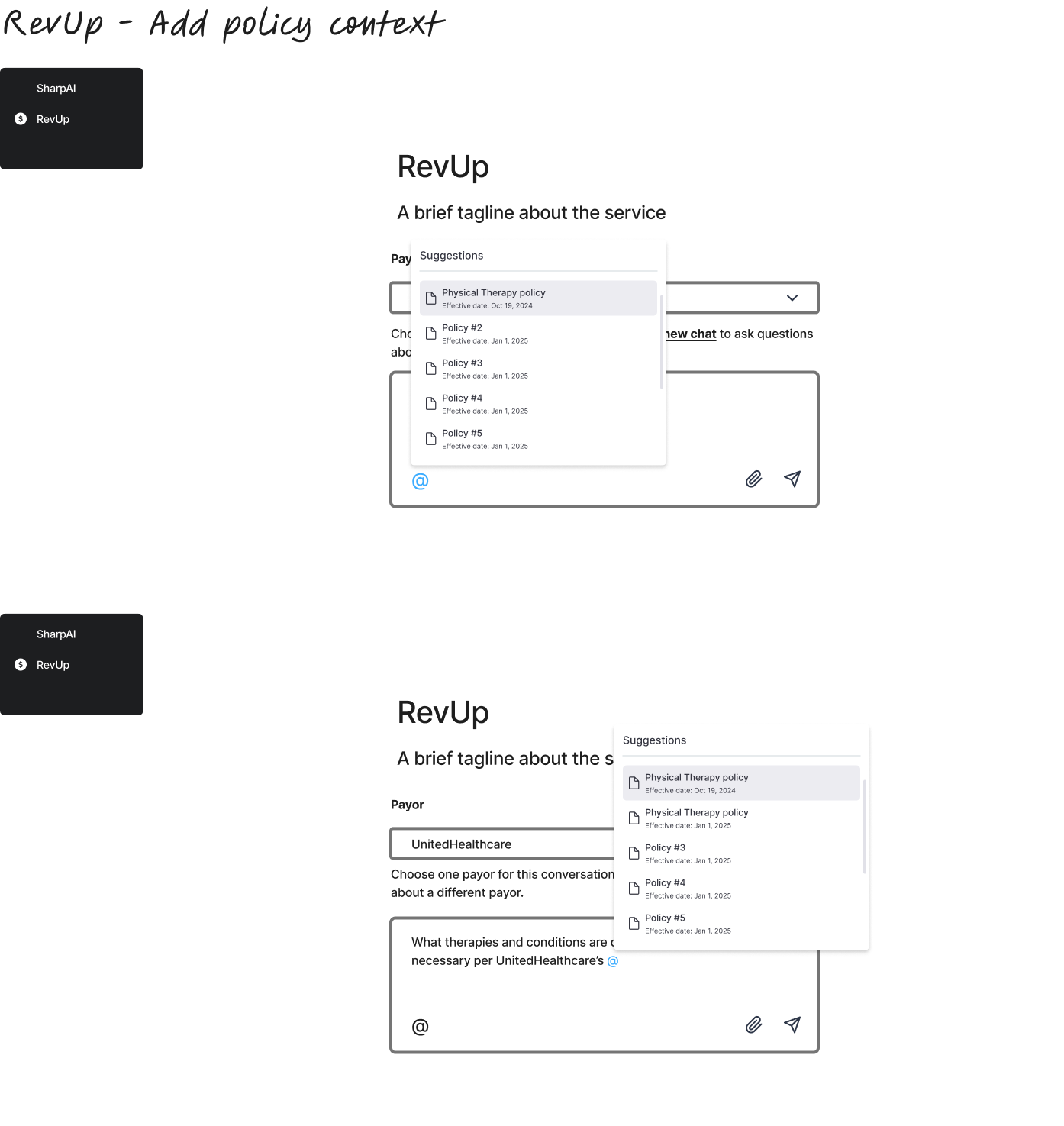
My initial wireframes explored structured inputs alongside natural language to improve retrieval quality, reduce ambiguity, and help users start with the right context. Some interactions for the early phases included:

• Payor dropdown for insurance selection (to narrow document corpus)
• Ability to add own sources
• Ability to search for specific sources
• Date selector (since rules change over time)


Althought setting these constraints gave users clear indication they were retrieving the correct information and reduced ambiguity for the AI, it placed too much friction in the experience and put too much burden on the user. During user feedback, we repeatedly heard from users they wanted to "do less" and get the information they needed.
As I learned more about the desired workflow and as engineering matured the retrieval strategy, I realized ontext could be inferred from the user's questions, pulled from the claim itself, or be requested when necessary. The result was a much simpler interaction model.

Exploring how to build trust for our users

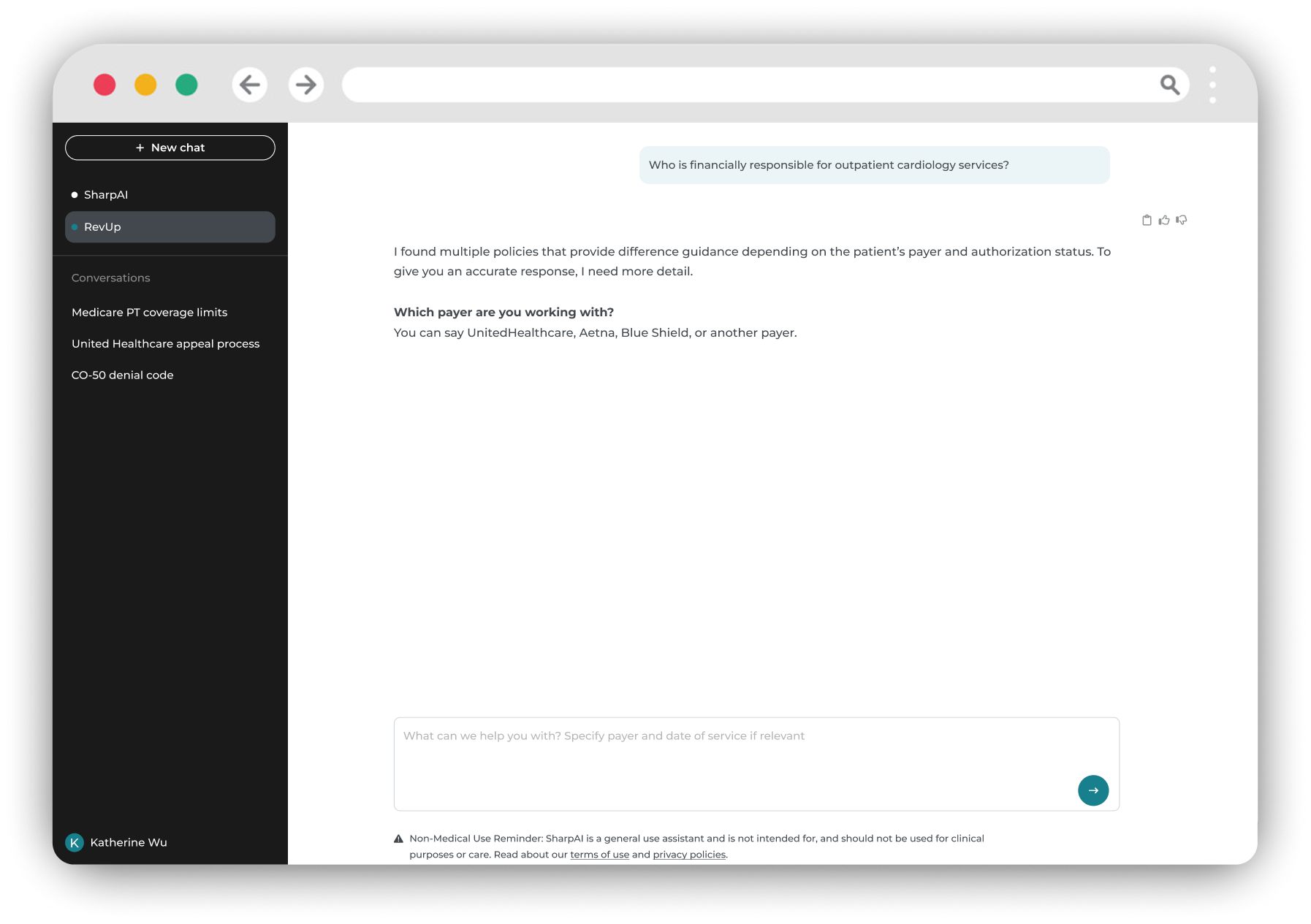
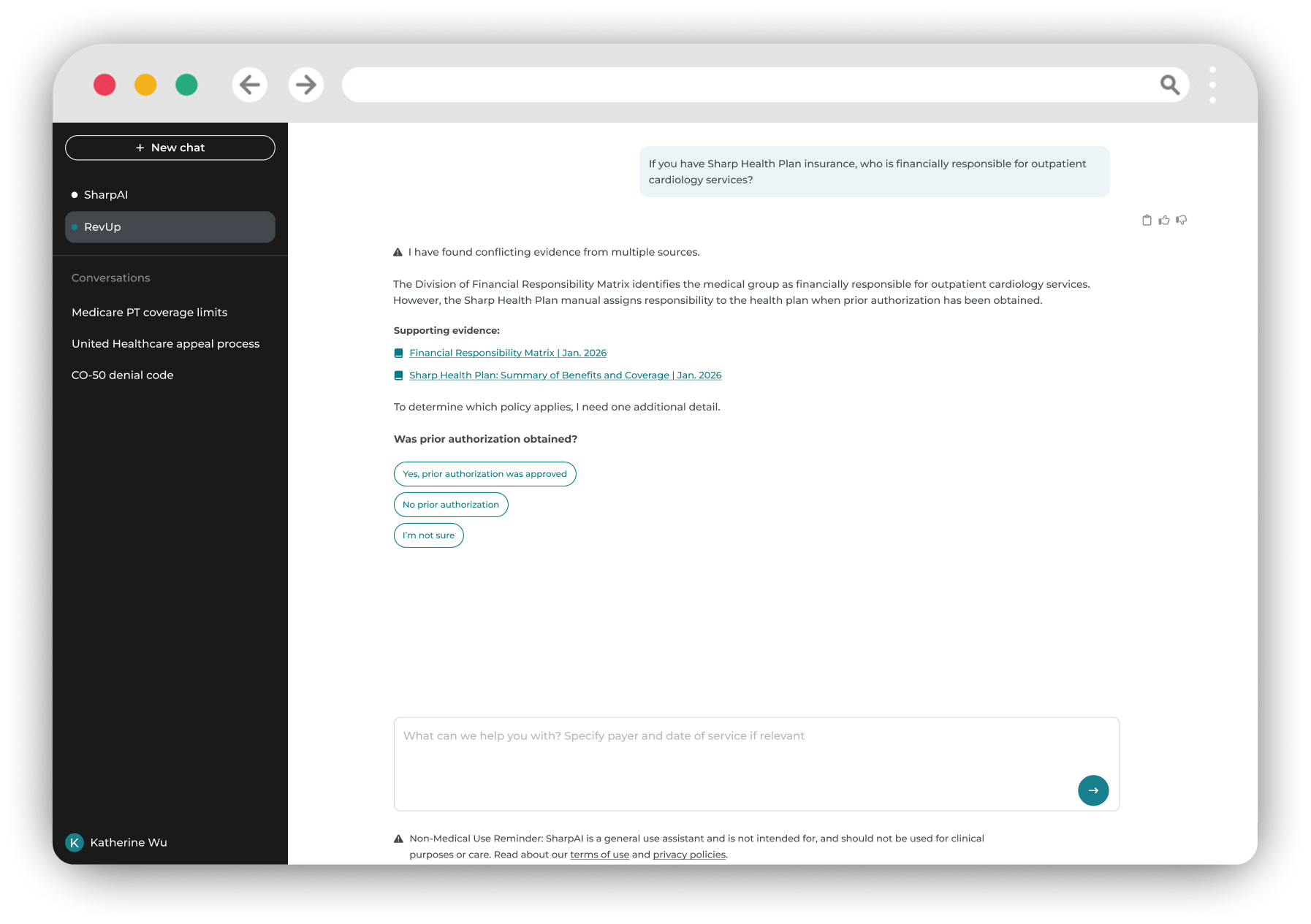
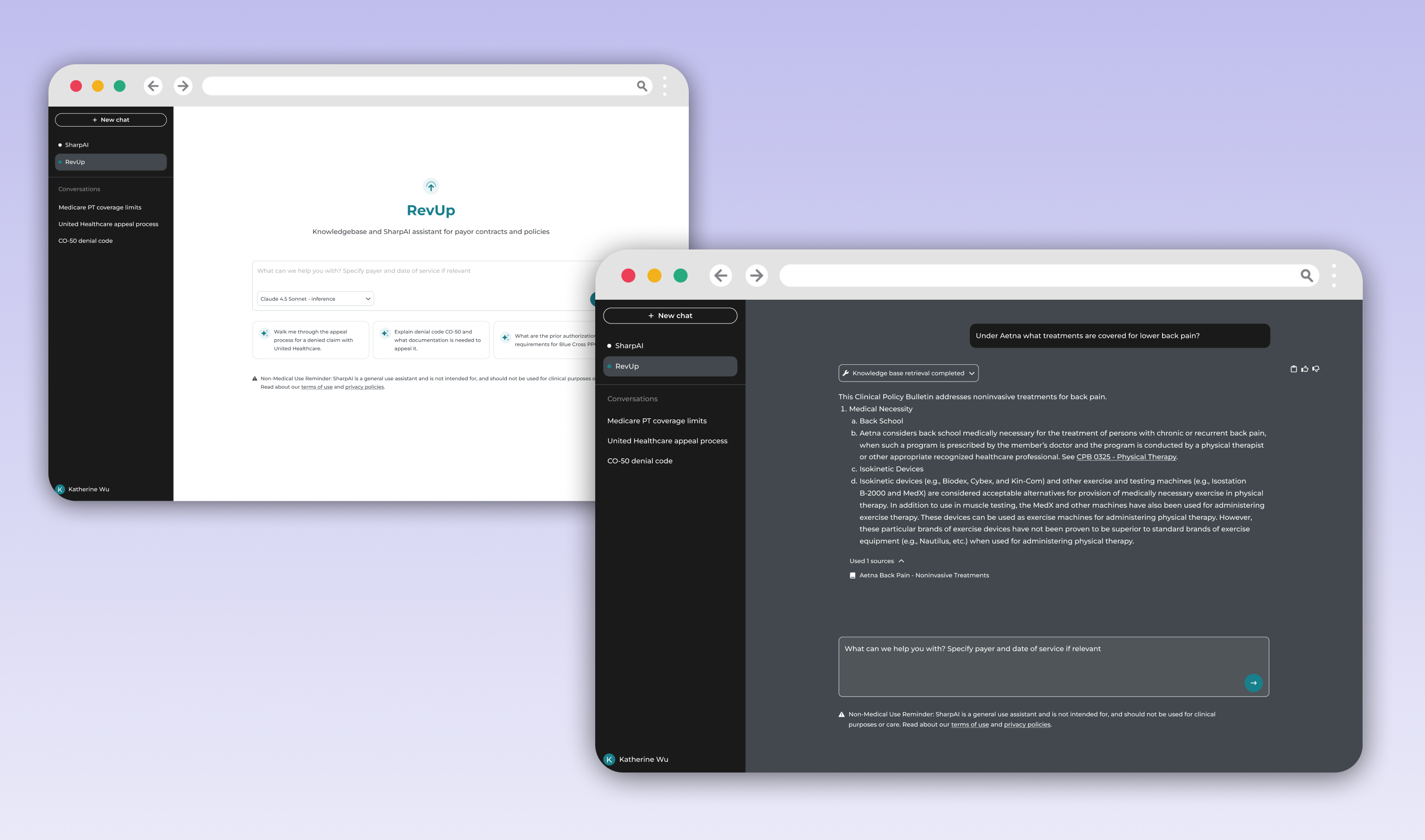
Our AI assistant brought claims research into a unified conversational workspace. Specialists could ask questions in natural language and receive a concise response grounded in relevant documentation. In order to build trust and confidence for our users, the following interactions were included in the final product:

• Synthesized responses based on approved sources
• Sources to back up specific claims
• Direct access to original documents
• Clear handling of missing or conflicting evidence

Partnering through implementation

I worked closely with engineering and data teams to align the experience with the capabilities and limitations of the retrieval-augmented generation (RAG) system. Together, we worked through:

• Source ingestion and document quality
• Citation accuracy
• Response structure
• Follow-up behavior
• Empty and low-confidence states
• Conflicting evidence
• Technical feasibility for the proof of concept

The product evolved iteratively as the prototype revealed both workflow needs and technical constraints.

Reflection

RevUp reinforced that the strongest AI products begin with a well-understood workflow. The opportunity was not to automate the claims specialist’s judgment but to remove the fragmented research burden surrounding that judgment and make trusted evidence easier to access. In high-stakes workflows, responsible AI should help people move faster while making the evidence behind each answer more visible.

RevUp not only resulted in a more efficient and trustworthy workflow for our claims team, but it is a reusable model for role-specific AI workflows at Sharp.

Next project: Clinical decision support platform for cardiovascular analysis

Back to top